If you’ve started researching Cavoodle puppies, you’ve probably come across terms like F1, F1B, and F2. These labels describe a puppy’s breeding lineage, but they don’t tell the whole story.
Many online articles simplify Cavoodle generations into neat categories. In reality, responsible breeding has evolved considerably. Experienced breeders now look beyond generation labels and use genetic testing, health screening, coat genetics, and carefully planned pairings to produce healthy puppies with predictable traits.
At Glenroy Cavoodles, our breeding decisions are based on much more than whether a puppy is F1 or F2. Health, temperament, genetic diversity, and coat genetics all play an important role in planning each litter.
Understanding the Early Generations
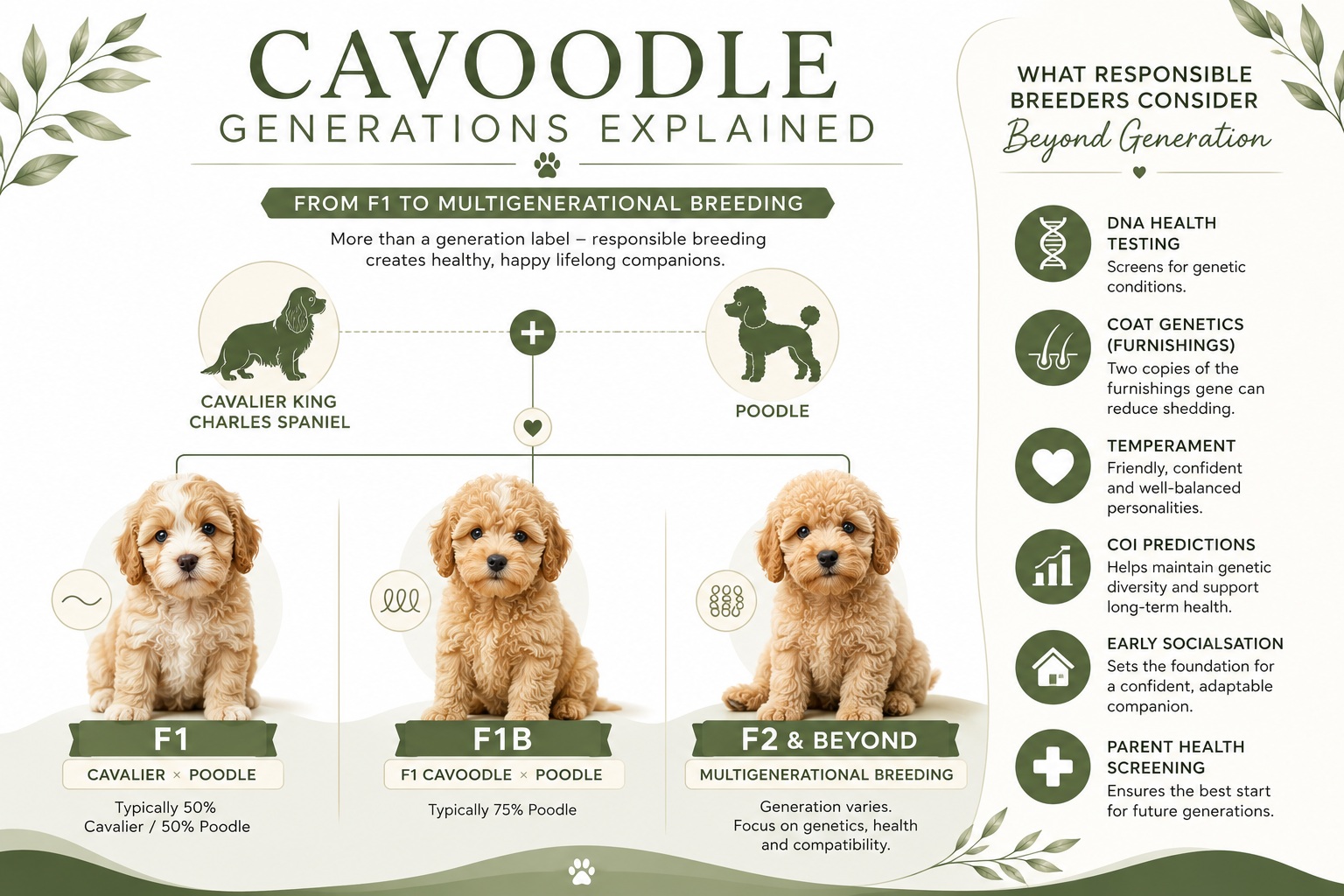
The “F” stands for filial generation, referring to how far a puppy is removed from the original Cavalier King Charles Spaniel × Poodle cross.
| Generation | Parents | Typical Genetic Makeup |
|---|---|---|
| F1 | Cavalier King Charles Spaniel × Poodle | Approximately 50% Cavalier / 50% Poodle |
| F1B | F1 Cavoodle × Poodle | Approximately 75% Poodle |
| F2 | F1 Cavoodle × F1 Cavoodle | Varies due to inheritance |
These generations provide a useful introduction, but they represent only the beginning of modern Cavoodle breeding.
Beyond F2: Understanding Multigenerational Cavoodles
Many established breeding programs now produce multigenerational Cavoodles, sometimes referred to as “multigens.”
Rather than repeatedly creating first-generation crosses, breeders selectively combine later-generation Cavoodles to preserve desirable traits while maintaining healthy genetic diversity.
For example, one litter may be produced from an F4 Cavoodle bred with an F1 Cavoodle. Although this would generally be considered a multigenerational litter, the specific breeding is carefully chosen to achieve particular health, temperament and coat goals rather than simply creating another numbered generation.
As breeding programs mature over time, generation labels become less meaningful on their own. What matters most is the quality of the breeding program behind each puppy.
Does Generation Determine Shedding?
One of the biggest misconceptions is that an F1B always sheds less than an F1 or F2.
While earlier-generation Cavoodles can show more variation in coat type, generation alone does not determine how much a dog will shed.
Modern breeders now understand that coat genetics, particularly the furnishings gene, play a much larger role.
Dogs that inherit two copies of the furnishings gene are generally more likely to develop the low-shedding coat many families associate with Cavoodles.
This means that a carefully bred F2 or multigenerational Cavoodle with the appropriate coat genetics may shed less than an F1B.
Although no dog can be guaranteed to be completely non-shedding or suitable for every allergy sufferer, genetic testing allows breeders to make more informed predictions than relying on generation labels alone.
Responsible Breeding Is About More Than Generations
At Glenroy Cavoodles, planning a litter involves far more than pairing two dogs from a particular generation.
Every breeding decision considers multiple factors, including:
- Comprehensive DNA health testing
- Temperament and suitability as family companions
- Structural soundness
- Coat genetics
- Genetic diversity
- Long-term breeding goals
Generation is simply one piece of a much larger picture.
Why COI Matters
Another important tool used by responsible breeders is the Coefficient of Inbreeding (COI).
COI predicts how closely related two breeding dogs are.
Rather than relying only on pedigree charts, COI calculations help breeders evaluate genetic diversity when planning future litters.
Lower predicted COI values generally indicate greater genetic diversity, which can support healthier breeding outcomes when considered alongside DNA health testing and responsible breeding practices.
Using COI predictions is one of several ways experienced breeders make informed pairing decisions for future generations.
Choosing the Right Cavoodle Isn’t Just About F1 or F2
When choosing a puppy, it’s natural to ask whether F1, F1B or F2 is “best.”
The reality is that there isn’t a universally best generation.
Instead, prospective owners should look for breeders who:
- DNA health test their breeding dogs
- Carefully plan each mating
- Consider coat genetics rather than relying only on generations
- Use tools such as COI predictions to guide breeding decisions
- Prioritise temperament and lifelong health
- Raise puppies in a nurturing family environment
These practices have a much greater influence on the quality of a puppy than the generation number alone.
The Glenroy Cavoodles Difference
At Glenroy Cavoodles, our breeding philosophy extends well beyond traditional generation labels.
Whether a litter is F1, F2 or multigenerational, every pairing is carefully planned using modern breeding principles that consider health, temperament, genetic diversity and coat genetics.
Our goal is not simply to produce Cavoodles of a particular generation, but to raise healthy, confident and well-socialised companions that thrive in Australian family homes.
FAQ
Is an F1B Cavoodle always better than an F2?
No. While F1B Cavoodles are often associated with curlier coats, a carefully bred F2 or multigenerational Cavoodle may have equally desirable coat characteristics. Responsible breeding, health testing and coat genetics are more important than the generation label.
What is a multigenerational Cavoodle?
A multigenerational Cavoodle is produced by breeding later-generation Cavoodles rather than returning to the original Cavalier × Poodle cross. For example, an F4 Cavoodle may be bred with an F1 Cavoodle as part of a carefully planned breeding program.
Does generation determine whether a Cavoodle sheds?
Not on its own. Shedding is influenced by several genetic factors, including the furnishings gene. Responsible breeders increasingly use DNA testing and coat genetics to help predict coat characteristics.
What is COI?
COI, or Coefficient of Inbreeding, estimates how closely related two breeding dogs are. Alongside health testing and genetic screening, it helps breeders make informed decisions that support long-term genetic diversity and healthier future generations.
Common Myths About Cavoodle Generations
With so much information available online, it’s easy to come across misconceptions about Cavoodle generations. Here are some of the most common myths.
Myth 1: F1B Cavoodles Are Always Better
There is no “best” generation. An F1B, F2 or multigenerational Cavoodle can all make wonderful family companions when responsibly bred. Health, temperament and ethical breeding practices matter far more than the generation label.
Myth 2: Later Generations Are Less Healthy
Health isn’t determined by whether a puppy is F1, F2 or multigenerational. Responsible breeders improve breeding outcomes through DNA health testing, careful mate selection and genetic diversity rather than simply producing a particular generation.
Myth 3: Generation Predicts Coat Type
Generation offers only a general indication. Coat genetics, particularly the furnishings gene and other inherited coat traits, provide a much better indication of whether a puppy is likely to have a straighter, wavy or curlier coat.
Myth 4: All Cavoodles Are Hypoallergenic
No dog breed is completely hypoallergenic. While many Cavoodles have coats that shed less than some other breeds, individual allergy responses vary and no breeder can guarantee an allergy-free puppy.
What Should You Ask a Breeder?
Instead of asking only whether a puppy is F1 or F2, consider asking questions that provide a better understanding of the breeder’s program.
For example:
- Are the breeding dogs DNA health tested?
- What health screening is performed before breeding?
- How are breeding pairs selected?
- Are COI predictions considered when planning litters?
- How are puppies socialised before going home?
- What ongoing support is provided after adoption?
- Can you explain the coat genetics behind this litter?
A reputable breeder will be happy to discuss these topics and explain the reasoning behind each planned mating.
Choosing the Right Cavoodle for Your Family
Every family has different expectations. Some are looking for an active walking companion, while others want a relaxed dog that enjoys spending time indoors with the family.
The right puppy isn’t necessarily determined by whether it’s F1, F1B or multigenerational. Instead, the best match comes from combining:
- A responsible breeding program
- Health-tested parents
- Appropriate temperament
- Early socialisation
- Honest guidance from an experienced breeder
Taking the time to understand your lifestyle and expectations allows a breeder to recommend the puppy most likely to thrive in your home.
Final Thoughts
Generation labels such as F1, F1B and F2 are useful for understanding a Cavoodle’s breeding background, but they are only one part of the story.
Modern, ethical breeding programs increasingly focus on the factors that have the greatest influence on long-term health and predictability, including DNA health testing, coat genetics, temperament, genetic diversity and COI-informed breeding decisions.
At Glenroy Cavoodles, every litter is thoughtfully planned using these principles. Whether we’re producing an F1, an F2 or a carefully selected multigenerational litter, our goal remains the same: to raise healthy, well-adjusted Cavoodles that become lifelong members of Australian families.